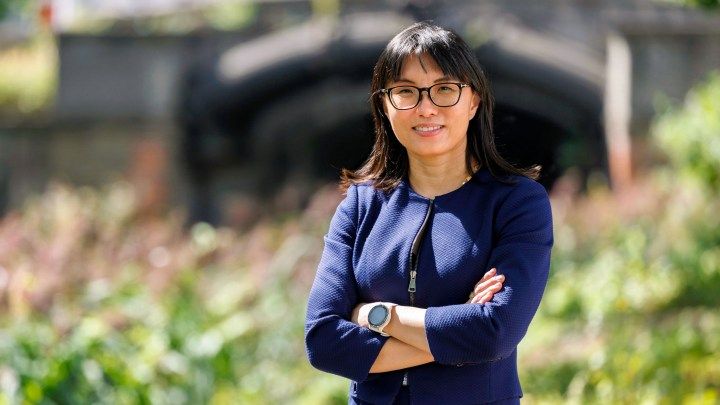
A Quantum Leap for Programming: Si-Hui Tan, PhD ’10

Ask Aria
Have questions? Ask the Engine Blog AI Assistant in real-time.
As a young girl, Si-Hui Tan, PhD ’10, started studying science almost as a challenge.
“I grew up in Singapore, where science is considered a boy thing,” she says. “I wanted to prove that I could do it too, despite being a girl. And then it got me.”
A handful of decades and an MIT physics doctorate later, Tan is the chief science officer (CSO) of Horizon Quantum, a Singapore-based startup that seeks to help software developers make the leap from classical to quantum computing. Quantum computers promise to deliver significantly more processing power than conventional computers because they are not limited to storing data in binary code—represented by 0s and 1s.
Quantum bits, or qubits, provide exponentially more storage because in addition to representing a 0 or a 1, they can exist in the somewhat mindbending quantum state known as superposition, meaning they can simultaneously be a 0 and a 1 and everything in between.
Writing algorithms for quantum computers today requires specialized skills, so Horizon aims to pioneer a method developers can use to create quantum algorithms using source code written in conventional programming languages.
“We believe that speeding up coding will help quantum reach its potential sooner,” Tan says.
Though the field is growing, it is arguably in its infancy. State-of-the-art quantum systems have more than 1,000 qubits, but that’s still a far cry from the processing power necessary to improve the efficiency of resource-hungry algorithms in areas such as pharmaceutical drug discovery, computational fluid dynamics, and financial portfolio optimization. Eventually, though, Horizon is convinced that quantum systems can power the world’s most complicated calculations—and Tan believes Horizon’s developer platform will be ready.
“I think that there are things out there that could be very impactful very quickly,” she says. For example, a portfolio manager modeling interest rates today needs a lot of processing power to calculate exponents for numbers with fractions. It is not uncommon for such calculations to be made millions of times, Tan says, so if quantum computing could speed up those calculations by even 1%, “the impact could potentially be huge.”
Tan studied quantum computing at MIT after earning her undergraduate degree in physics at Caltech. It was a challenging path, but it also provided her with a refuge.
“I had a lot of anxiety—still do,” she says. “When I read about physics, I just found it comforting. You learn about Newton’s laws, and then you learn about the cosmos. I was very influenced by Hawking’s writing, Feynman’s writing. There’s something about sitting down, discovering rules about how things work. And I guess in a way it’s almost spiritual, because it’s something bigger than yourself, and yet rules are there.”
Tan also joined the ballroom dance team at MIT, an experience that is still paying dividends. “I went to competitions, I had to talk to dance coaches, I met people from other teams,” she says. “That socialization, being able to talk about everything and being interested in people—that’s also a skill. That’s helped a lot in my professional life right now.”
After completing her MIT degree, Tan returned to Singapore to work for a national lab focused on semiconductors for quantum applications before joining Singapore’s Centre for Quantum Technologies. There she met Joe Fitzsimons, who went on to found Horizon and asked her to become one of its first employees when it launched in 2019.
Tan and Fitzsimons have since built Horizon’s team of scientists, engineers, and product designers to develop software products in hopes of ensuring that the software world is ready when the full potential of quantum computing is realized.
“It really takes a village to try to get something to work,” she says. “It’s not just knowing quantum computing. Getting into proximity with people who have other skill sets is absolutely critical to getting quantum computing to work. As a CSO, you definitely have to know that you don’t know everything.”
Source: MIT Technology Review
Share this article
Related Articles
Hand-picked posts you might enjoy