Sumerians were the first settlers of sumer between the Tigris and Euphrates rivers

Ask Aria
Have questions? Ask the Engine Blog AI Assistant in real-time.
Sumerians were the first known people to settle in Sumer between the Tigris and Euphrates rivers (in modern day Iraq), later known as Mesopotamia, over 7000 years ago. The Sumerian civilisation, which flourished between 4500-1900 BC, was known for its significant inventions, innovative technologies and varied city-states. Often nicknamed the ‘cradle of civilisation‘, by 4th Millennium BC, Sumer had established an advanced writing system, enjoyed spectacular arts and architecture, and pioneered mathematical and astrological practices. Sumerians also followed a complex, polytheistic religion, worshipping a significant number of deities. Deities were anthropomorphic, meant to represent the natural forces of the world, and likely numbered in the hundreds or even thousands. Nonetheless, some gods and goddesses were more prominently featured and worshipped within the religion of Sumer, so can be considered to be the main deities worshipped by the civilisation.
• An: Lord of the heavens:
The most important god in the Sumerian pantheon is An, who, as supreme deity, was believed to be a sky god and initially Lord of the Heavens. Dating from at least 3000 BC, he was originally envisaged as a great bull, a form which was later separated into a mythological entity known as the Bull of Heaven. His holy city was Uruk in the southern herding region. Later, An’s leadership role was later shared or taken over by other gods; nonetheless, deities were still said to have received the ‘anûtu’ (‘An power’), demonstrating that his exalted status was maintained throughout.
• Enlil: God of the atmosphere:
Enlil, the god of the wind, air, earth and storms, was a chief deity of the Sumerian pantheon, but was later worshipped by other civilisations such as Babylonians and Assyrians. He played a vital role in creation myth, separating his parents An (heaven) from Ki (earth), thus making the earth habitable for humans. His breath was said to create the wind, storms and hurricanes. Enlil is also said to have created a flood to exterminate the human race because they made too much noise and prevented him from sleeping. He was also regarded as the inventor of the mattock, a hand tool used for farming, and was the patron of agriculture.
• Enki: Creator of mankind:
Enki, the Sumerian god of water, knowledge, crafts, magic and incantations, was credited with the creation of mankind, and was also regarded as its protector. For instance, he warned of the flood created by Enlil which was intended to eradicate the human race. He is depicted in iconography as a bearded man wearing a horned cap and long robes, often ascending the Mountain of the Sunrise. He was a very popular god amongst the Sumerians.
• Inanna: Queen of heaven:
Known as the ‘Queen of Heaven’, Inanna was probably the most popular god of the Sumerian pantheon. The goddess of sexuality, passion, love and war, Inanna was associated with the planet Venus, while her most prominent symbols included the lion and eight-pointed star. In many of the most famous and replicated Sumerian stories, myths and hymns such as ‘The Descent of Inanna’, ‘The Huluppu Tree’, and ‘Inanna and the God of Wisdom’, Inanna played a prominent role.
• Utu: God of the sun:
The Sumerian god of the sun and divine justice, Utu is the son of the moon god Nanna and the fertility goddess Ningal, and the twin of goddess of sexuality, passion, love and war Inanna. He has been written about as early as 3500 BC, and is normally depicted as an old man with a long beard whose shoulder emanate rays of light, or as a solar disc. ‘Law Code of Hammurabi’ (1792-1750 BC) addresses Utu by the name Shamash, and claims it was he who provided humanity with law.
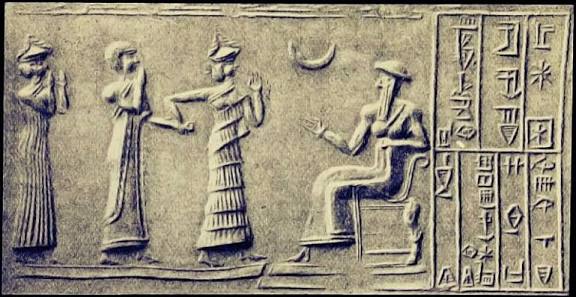
📷 : King of Ur performing an act of worship before Enzu, or Sin, the Moon-God (2500 BC); Image from page 34 of 'Babylonian religion and mythology' (1899)